“Listening and Sounding at an Angle” SAR Forum 2026
Poster presentation
Listening and Sounding at an Angle
Rachel Beckles Willson and Martina Raponi
at "Endangered Conceptual Worlds"
SAR Forum 2026
Listening and Sounding at an Angle
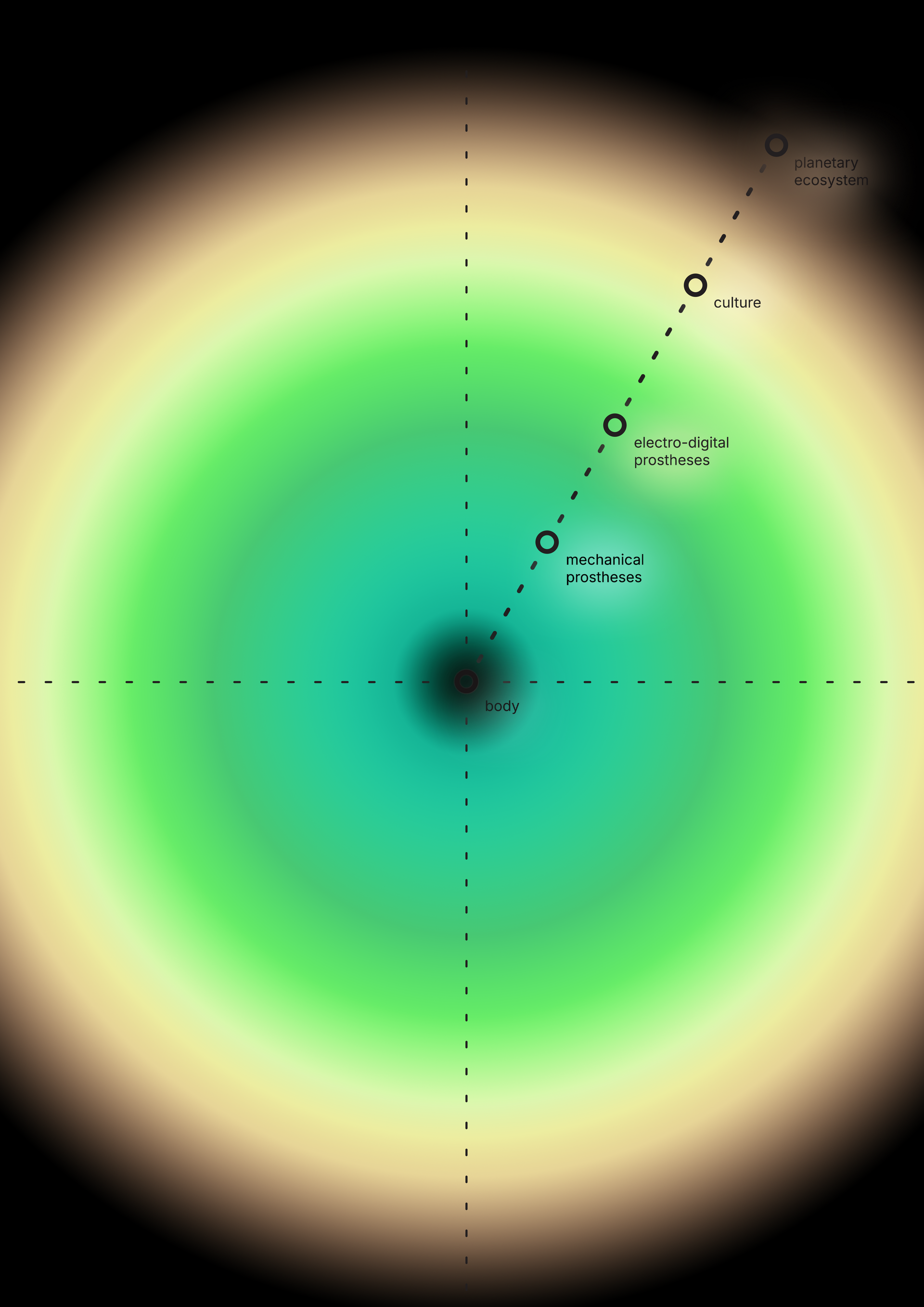
The poster offers an aesthetic rendering of a generative schema, or diagram, for exploring our proposition Listening and Sounding at an Angle. (Refer to the image below the video on this page for the clean diagram visualization).
Radiating outwards from a central body are entities that mediate experience. Closest to us are mechanical and electro-digital prostheses that translate sensory data. Further away, through the cultural layer and beyond, the planetary ecosystem partially shares the colour of the body itself, symbolising our intimacy within the largest context we know.
The norms of sounding and listening are represented by vertical and horizontal lines through the scheme.
Our proposition emerges from our questions and provocations starting at the bottom of the poster. From these we cut through the scheme at an angle, playfully entangling our two research trajectories in collaborative visualizations in a fanning out of experiences in the upper region.
The basis for these visualizations is documentation from Beckles Willson’s research into the infrastructures that sustain “nature” in the Brienenoord Island (Rotterdam, Netherlands), specifically the lives of trees. The documentation is overlaid by illustrations of signs (in both LIS and NGT)* drawn from Raponi’s research into Deaf acoustemologies; these poetically, rhythmically, and sonically narrate or comment on the images. While the signs challenge the centrality of cochlear perception (foregrounding sign as a core generative element for the production of sonic culture and knowledge within Deaf communities), the tree images embody the active presence of interspecies silence that may be generative of multi-modal responsiveness.
The interspecies silence, taken as an active presence rather than an absence, and the non-cochlear knowledge of Deaf sonic practices, each embody what sound excludes in order to constitute itself. Read together, they point toward a critical vocabulary in which ecosystems and sign languages become generative of new relational spaces, namely non-cochlear attunements that may be the most radical proposition of sound.
While read as a schema, the poster maps the emerging entanglement of Beckles Willson and Raponi’s work. However, it could also function as a diagnostic and analytic tool, more like a diagram. Read as such, it foregrounds non-normative and non-established elements that are often overlooked and left uncategorized within sonic practices and sonic discourse. Sonic practices and sonic works may be positioned between the lines and the gradients as a way of resituating them.
Our poster presentation visualizes and maps our complementary projects: listening with other-than-human entities, and acknowledging Deaf sound practices within sonic discourses. Read in this way, the diagonal cut through the schema becomes a method for reorienting sonic inquiry. Rather than treating hearing as the primary condition of sound, it foregrounds forms of attunement that arise through sign, silence, embodiment, and ecological relation. The poster therefore proposes an expanded understanding of sonic experience—one that begins from what dominant sonic discourses have often left at their margins.
*The sign illustrations have been sourced from Virginia Volterra (Ed.), La Lingua dei Segni Italiana. La Comunicazione Visivo-Gestuale dei Sordi, Il Mulino, 2004 and Trude Schermer and Corline Koolhof (Eds.), Van Dale Basiswoordenboek Nederlandse Gebarentaal, Van Dale, 2009
The broader project
Sound is immersive and distributed. In distinction from visual stimuli, it works on us through a range of sensorial channels. In its rich vibrational embodiment it affords the construction of unique epistemologies (acoustemologies). But what methods do we have with which to develop these ways of knowing through sound? And what happens when our strategies fail us, when we encounter only silence? What can such moments of sound’s apparent failure teach us about relationality and coexistence?
Questions we are investigating include the value of vegetal silence for confounding listening assumptions. Plants do not communicate with sound that we can hear, and sound artists often resort to translating other data into sound. But what if we work instead with the interspecies silence as an active presence and allow it to be a paradoxical catalyst for more complex co-creation? Could it help us attune more deeply to an ethics of care, restraint, and multimodal responsiveness to ecological contexts?
Deaf sonic practices challenge the presumed cochlearity of listening and sounding: they call for the widening of our analytical and sensorial tools to describe and appreciate the sonic knowledge that is produced outside (below, beyond) the thesholds of audibility. How to account for sound practices that preferentially utilize (sing) language (in its somatic and rhythmic articulation) as a basic compositional tool? How can we redirect the “negative potential” of sound as “what is known by exclusion,” without reaffirming normative and audist epistemes?
We visualize and complicate the dynamic meeting point between the heard and the unheard, and point to possible answers to the following questions encompassing our two perspectives: how can sonic practices test the elasticity of perceptual and conceptual frameworks? How can we engage with movements, capacities, rhythms, and temporalities that lie outside our normal listening tendencies? How can we create a critical vocabulary that acknowledges the language of ecosystems and sign languages as generative of new relational spaces of non-cochlear attunement?
Does this challenge to our listening open a critical perspective on what we think investigative listening is, and how we might reconfigure our practices?
Biographies
Prof. dr. Rachel Beckles Willson has a hybrid professional arts practice as an audio-visual artist and composer, performer and widely-published scholar. Her current research interests lie in relationships with the other-than-human, and the development of sustainable multi-media technologies. These have grown out of earlier work in the Middle East on cultural imperialism and decoloniality, the cultural life of musical instruments, and activist work with people on the move in Europe. Her early career was as a concert pianist, while her career as a scholar began with PhD studies at King’s College London. She is now Professor of Performative Art Research, Sound, and Society at Willem de Kooning Academie in Rotterdam, and the Academy of Creative and Performing Arts (ACPA), Leiden University.
Martina Raponi is a writer and an artist researching noise and the unheard through writing, sound performance, expanded reality, interactive installations, and workshop activations. She published her first book, “Strategie del Rumore. Interferenze tra Arte Filosofia e Underground,” in 2015, and her second book, “Psofotopias. Noise: Sounding Out the Unheard,” in 2025. Martina is co-founder of noiserr, an interdisciplinary research group focused on noise. With artist [M] Dudeck, Martina founded the Ansible Institute, a transitory speculative fiction laboratory. She is part of the Noise Research Union, is an art theory tutor at the Willem de Kooning Academy in Rotterdam, and a PhD candidate at ASCA (University of Amsterdam).
Rachel and Martina have recently begun collaborating on research in Sound, and on a new educational trajectory in Sonic Cultures to be developed at WdKA. Their work contributes to current debates and explorations of urgent sonic themes and practices. Their interests intersect at the infrastructural complexity that emerges when the notion of intuitive perception is complicated.
Artistic research trajectories of the artists
Rachel Beckles Willson’s artistic research attends to living systems at the margins of environmental management. It asks what forms of agency, endurance, and relation persist where the illusion of human ordering loosens its grip. It engages with debates around the Anthropocene (Haraway, Tsing) and postnature (Morton) through situated, practice-based encounter.
Current audio and film practice focuses on salix alba (white willow trees) that live while leaning into a tidal river, their roots cycling between exposure and submersion twice daily. Along streets and riverbanks nearby, trees are lined up like soldiers, with cooling or wind-breaking tasks to perform; but these have been allowed to pursue their own growth, negotiation, and partial collapse. No longer upright, and with their roots so often exposed, they are no longer legible in the register of tree dignity and utility.
The research lies in multiple attempts at sonic attunement that keeps being pushed back to the very infrastructure the trees only seem to have escaped. Deep listening among the trees, or close listening with varying types of technological support, increases awareness of the cement factory on the opposite riverbank and the traffic from the nearby highway.
Exploration of the ecosystem of roots leads to enhanced sensitivity to the river pollution the trees inhabit. Each attempt to reach toward the trees loops back through the noise that is also, inescapably, part of their world and ours.
But it also generates an uncanny sense of the trees’ own language of capacity and endurance, signalling strengths far exceeding what humans manage. Their roots protect the riverbank from erosion, they chew up and crush the rubble of human construction-destruction, they tolerate the industrial toxicity of the river, and they seed themselves constantly. These processes unfold in durations and registers that exceed our perceptual grasp — in languages of endurance, slow chemistry, and material negotiation that we can attend to but never quite hear.
The practice is developing iteratively in collaborative broadcasts, installation-performances, and a site-specific, tide-driven musical instrument. But in the first iteration of this instrument, built among the trees, it is passing boats rather than the tide itself that drives the water to actually produce sound. The device acts like a “toy” (Morton), looping away from the local play of tide to the global question of human movement and energy.
The practice and its outcomes embody loops of frustration and confrontation — generative failures with knowledge that arrives when we stay inside the dark ecological mesh rather than conjuring a position outside it. What emerges is not a map of nature beyond management, but a deepened sense of what persists, negotiates, and endures within it.
Martina Raponi meditates critically on the fetish of listening that has been pervading the cultural sector in the last years. In order to complicate the notion of listening in an inclusive manner, Martina, as an artist who is also a CODA (Child of Deaf Adults) asks: what constraints or affords the possibility of perceiving sound? How is sonic perception enabled by different cultures, languages, and technologies?
Integrating the non-cochlearity advocated by Seth Kim-Cohen, the political phenomenology of impairment advanced by Jonathan Sterne, and the critical listening positionality theorized by Dylan Robinson within his “hungry listening” proposition, led Raponi to a way to approach sounding and musicking practices by Deaf artists, performers, and cultural producers.
The unheard complicates the unsound proposed by Steve Goodman, which is typically understood as the unknown, the uncertainly known, of in- and non-human phenomena. The unheard emphasizes the constraints that shape the act of hearing, or more generally, sensing.
Non-cochlearity exceeds the jusrisdiction of the ear, expanding beyond “sound in itself”. The political phenomenology of impairment allows for a space of self determination by acknowledging the “normative” impairment that is allowed for within certain schemas of existence, mostly determined by technology or technologically determined taxonomies. The critical listening positionality foregrounds different listening perspectives that are informed by cultural palimpsests of practices and different layerings of cultural understandings.
Instead of departing from sonic practices by hearing individuals, Martina Raponi theorized the unheard by centering practices by Deaf and Hard of Hearing artists and performers, to offer a paradigm that destabilizes the normative assumption of what sound, hearing (or in general: sensing/perceiving sound), and music are.
The unheard is what is literally—to make a generalization—not heard by the Deaf; it is the metaphor of what is not heard of them and their culture within normative settings, their underrepresentation and the misunderstandings and stigmas that are usually associated with them; the unheard is also the whole array of influences and constraints that determine the way we perceive certain sounds or sonic practices. The oxymoron of Deaf Musicking is one example.
This led to a new work, made with creative coder Ymer Marinus, and commissioned by Noorderlicht, a lens-based media gallery in Groningen, in the North of the Netherlands.
The title of the work, unheard, hints at Raponi’s research, and it is representative of it insofar as it foregrounds sign language and the Deaf paradigm of perception.
The work was developed in collaboration with Turkoois, a Deaf organization that promotes Deaf culture and sign language. During the preliminary research sessions involving members of the Dutch Deaf community, we looked at AI-generated signing avatars, and meditated on projects based in the NL (SignOn at Tilburg Uni, and the Sign Bank at UvA), to proceed with discussions about the effectiveness of AI in generating reliable signing avatars, in translating sign languages. What are the community’s wishes? What happens with the signs collected by academic institutions? How are the Deaf centered in these projects? Are they just included following an extractivist logic? How do these projects serve the community?
This work uses a self-trained AI model, which recognizes certain signs (in NGT, Dutch Sign Lnaugage). The limitation of AI in recongizing sign languages is not highlighted here in a gimmicky way, making a sterile and tautological critique, but it is embedded within an interactive installation that enhances some of the gestural and bodily elements often disregarded by artificial intelligences when recognizing and translating sign language.
The installation responds to movements’ amplitudes and speeds with light and vibrations. When signing to the hand tracking sensor, the AI captures the signs and “rewards” the visitor by lighting up the sign, and activating a vibrational sequence that differs from the more contextual vibrations related to the other movements and gestures.
The work dismantles the notion of a 1:1 relationship between sign language and technological translation, or between sound and its translation into vibration. This is a critique generally put forward by Deaf artists and activists, who advocate for a more complex approach that does not reduce their culture, their language, their mode of sensing and existing in the world, to one over-simplified understanding. Deaf perception and the reticularity of different senses, visuality and iconicty of language.
This ultimately leads to Deaf Musicking: when signs become the fundamental compositional tool for making music, what kind of perceptual paradigm are we relying on? Can we, in good faith, exclude these practices from the sonic discourse, just because they do not produce an audible and possibly commodifiable product? What relationalities, modes of communicating and of making art, are promotedwith these practices? How can we produce cracks and openings from within the often stiff understanding of what listening and sound should mean and how they should be performed in the sensual world?